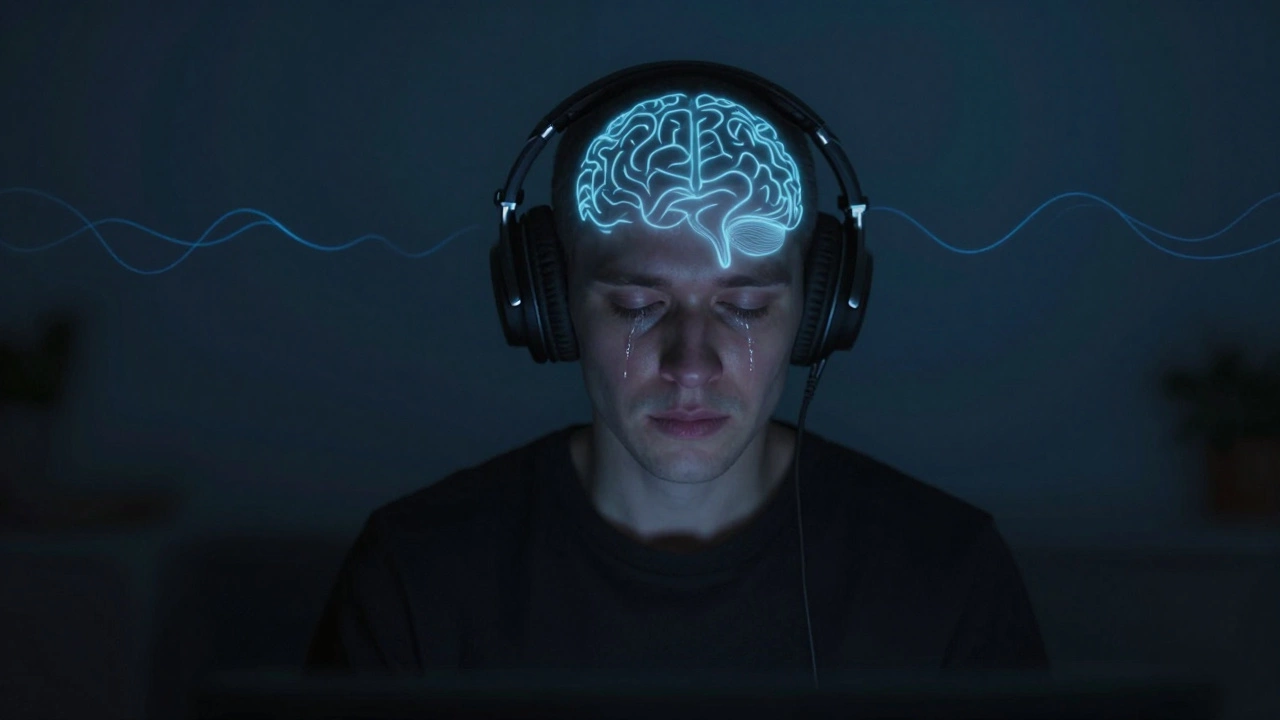
There’s a sound that doesn’t just reach your ears-it cracks open your skull and rewires your thoughts from the inside out. Arse Elektronika isn’t music in the traditional sense. It’s not meant for dancing, not for background noise, not even for listening with your eyes closed. It’s a sensory overload disguised as a tracklist, a collision of distorted bass, glitched-out vocal samples, and industrial percussion that feels less like a song and more like a neurological event. If you’ve ever felt your pulse sync with a beat so hard it made your teeth vibrate, you’ve been close. But Arse Elektronika doesn’t just sync-it hijacks.
Some people compare it to the raw energy of early industrial noise, or the chaotic structure of early Aphex Twin. Others say it’s what happens when a rave in Dubai’s desert meets a malfunctioning AI trying to recreate orgasmic feedback loops. One Reddit user summed it up perfectly: “It’s like your brain got a massage from a robot with a grudge.” And honestly? That’s the closest anyone’s come to describing it. If you’re curious about the kind of underground scenes that birth this kind of sound, you might stumble across thai escort dubai forums where people talk about sensory experiences in ways that surprise even seasoned clubbers.
What Makes Arse Elektronika Different?
Most electronic music builds tension and releases it. Arse Elektronika doesn’t release. It accumulates. Each track is a slow-burn pressure cooker. You hear a pulse-maybe a heartbeat, maybe a machine coughing. Then a layer of static, like a radio tuned between stations during a thunderstorm. Then a voice, chopped into syllables that mean nothing but feel everything. By the third minute, your body starts reacting before your mind catches up. Your shoulders tense. Your breath shortens. Your pupils dilate. It’s not about rhythm. It’s about resonance.
Unlike techno, which wants you to move, or ambient, which wants you to float, Arse Elektronika wants you to freeze. And then shatter.
The Origins: From Underground Labs to Global Noise
The project started in 2018 in a converted storage unit in Berlin, run by a former sound engineer who quit his job after a nervous breakdown triggered by years of mastering pop tracks. He called it Arse Elektronika as a middle finger to the industry-something ugly, unmarketable, and deeply personal. The first release, “Neural Feedback Loop v.0.1,” was uploaded to Bandcamp with no description. Just a 17-minute track and a single line: “This is what happens when you stop pretending music has to be pretty.”
Within six months, it went viral in underground circles. Not because it was easy to like-but because it was impossible to ignore. People started posting videos of themselves listening to it in total silence, eyes closed, tears streaming. One clip showed a man in Tokyo collapsing to his knees mid-listen, screaming without sound. Another showed a woman in Melbourne laughing hysterically for seven minutes straight after the final track ended.
The Science Behind the Sensation
Neuroscientists at the University of Auckland started studying Arse Elektronika in 2023 after a spike in patients reporting unusual brainwave patterns after listening. fMRI scans showed activity in areas typically associated with pain, pleasure, and memory-all firing at once. The brain doesn’t know how to categorize it. It’s not fear. It’s not joy. It’s something older. Something primal.
Dr. Linh Nguyen, who led the study, said: “It’s like the sound bypasses the cortex and speaks directly to the reptilian brain. It triggers a response we thought was lost to evolution-like the feeling of standing in a storm, knowing you’re small, and being okay with it.”
There’s no official explanation for why this happens. No known algorithm, no standard synthesis technique. The creator uses modified analog gear, custom software, and field recordings from abandoned hospitals and subway tunnels. Some tracks include the sound of a ventilator, a child’s whisper, and a metal door slamming shut-layered in reverse, pitch-shifted by 11 semitones, then drenched in 12 seconds of analog tape saturation.

How to Listen (Without Losing Your Mind)
You can’t play this on Spotify while you’re cooking. You can’t have it on in the background at work. Listening to Arse Elektronika requires intention. Here’s how to do it right:
- Find a dark room. No windows. No phone. No distractions.
- Wear over-ear headphones. Not noise-canceling-just good, old-school ones with solid bass response.
- Set the volume to 75%. Not louder. Not softer. That’s the sweet spot where your body feels it before your ears do.
- Close your eyes. Don’t think. Don’t analyze. Just let your nervous system react.
- After it ends, sit still for five minutes. Don’t move. Don’t speak. Let your brain reassemble itself.
Many listeners report vivid memories resurfacing-childhood smells, forgotten conversations, even dreams they haven’t had since they were teenagers. One woman in Oslo said she remembered her mother singing to her in a language she didn’t know. She later found out her mother had been Romanian, and the lullaby was real.
Why It’s Not for Everyone
Not everyone can handle it. Some people report nausea, panic attacks, or temporary dissociation. Others say it’s the most beautiful thing they’ve ever heard. There’s no in-between. It doesn’t care if you like it. It doesn’t want you to like it. It just wants you to feel it.
That’s why it’s growing. Not because it’s trendy. Not because it’s easy to stream. But because it’s real. In a world of algorithm-driven playlists and auto-tuned vocals, Arse Elektronika is the sound of something human trying to scream through the noise.

The Cult Around It
There are no official fan clubs. No merchandise. No social media accounts. But there are secret listening parties. People meet in basements, warehouses, and even abandoned churches. They bring their own headphones. They sit in silence. They don’t talk about the music afterward. They just nod. Sometimes they cry. Sometimes they don’t say anything for weeks.
There’s a rumor that the creator lives in a remote cabin in Iceland and only releases new tracks when the northern lights are visible. No one knows if it’s true. But in late 2024, a track called “Aurora Feedback” dropped-exactly 37 seconds long-and included a recording of wind at 67 degrees north. The timestamp matched the exact moment the aurora appeared over Reykjavik that night.
What Comes Next?
Arse Elektronika doesn’t tour. Doesn’t do interviews. Doesn’t explain anything. But fans are already speculating about the next release. Some say it’s a 40-minute piece made entirely from hospital monitors in a neonatal ward. Others swear they heard a sample of a woman saying, “I’m not scared anymore”-in a language no one can identify-on a leak from a private Discord server.
One thing’s certain: the next track will be louder. Slower. More broken. And it will change you.
If you’ve ever felt like your brain was too quiet, too safe, too tame-Arse Elektronika is your wake-up call. Not because it’s loud. But because it remembers what it means to be alive.
Some people say it’s the sound of a nervous system breaking. Others say it’s the sound of a soul finally speaking. Either way, you won’t forget it.
And if you’re still wondering why this matters? Look around. The world is full of noise. But very few things still have the power to make you feel something real. Arse Elektronika is one of them.
There’s a moment, right after the last beat fades, when your body remembers what it felt like to be startled by beauty. That’s the point. That’s the whole thing.
And if you need a distraction from the silence after it ends? You might find yourself scrolling through mature escort dubai blogs, searching for something equally raw, equally unfiltered.